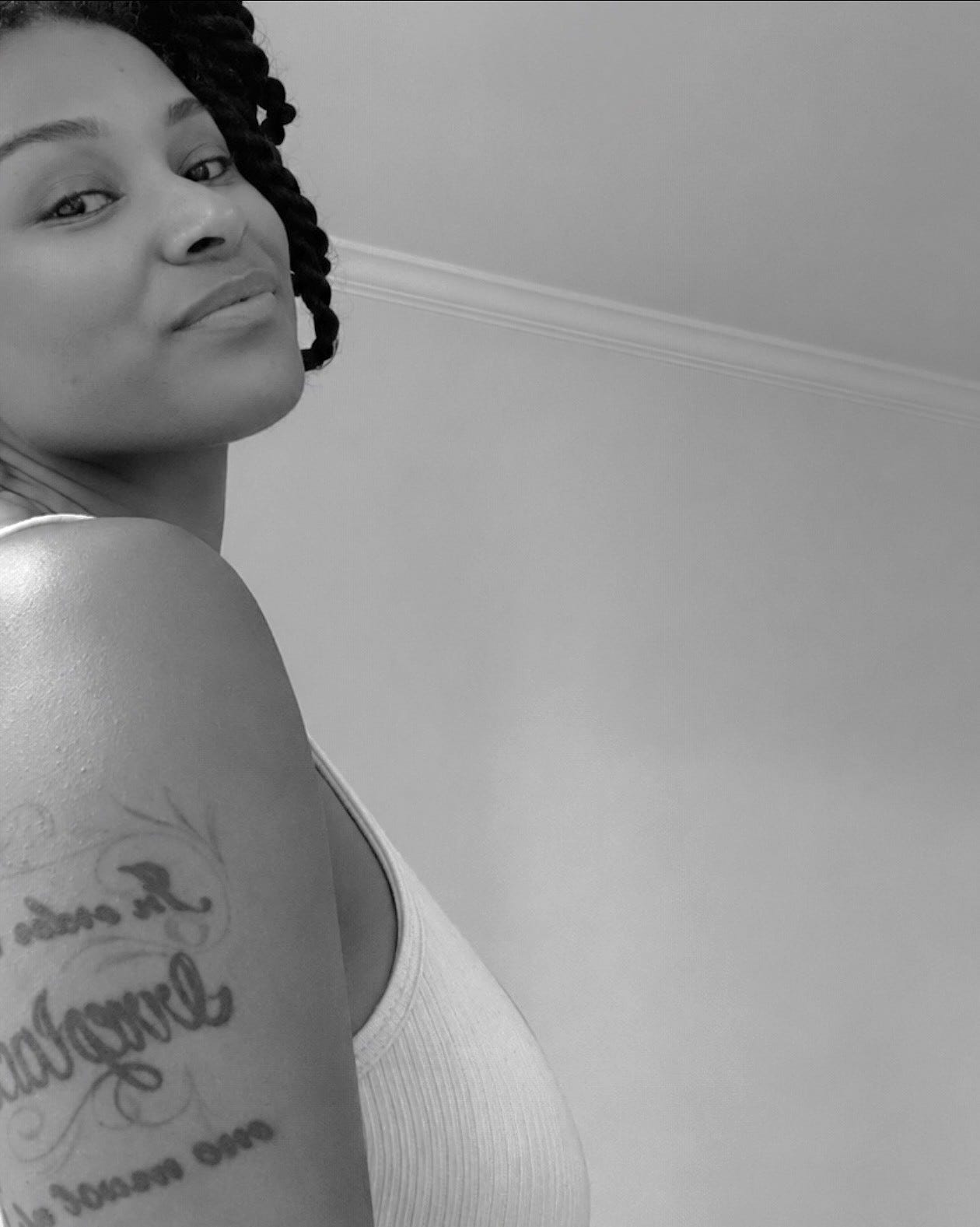
Tattoos. Pieces of art that we choose, carrying reminders of who we were when we chose them.
Joan Didion said, “I think we are well advised to keep on nodding terms with the people we used to be, whether we find them attractive company or not.”
Nodding terms to me feels like recognition without longing. Acknowledgement without wanting to go back.
I’ve gone through so many stages of loving and hating my tattoos, and I’ve always felt such discomfort with the back and forth. After paying hundreds (sometimes thousands) of dollars to lie in front of someone for hours and have them color into my skin, you’d think that a decision that expensive, painful, and permanent would require a sort of absolute and lasting clarity, but sometimes it’s not so black and white.
I have a Coco Chanel quote on the back of my arm that I’ve had a complicated relationship with over the years. For a long time, being embarrassed by it was more muscle memory than reaction. When other people ask the dreaded question, “What does your tattoo say?” I already had my response queued up, the mandatory motions I’ve come to know so well:
Put on a plain face, look slightly uncomfortable, but not too much, enough to show that I know it’s unimpressive. Make sure that THEY know that YOU know it’s cringe. Big sigh. Ready, recite: “In order to be irreplaceable, one must always be different.”
It’s exhausting.
I wasn’t embarrassed by its placement, but by how poorly it aged, and I don’t mean aesthetically. The ink never changed. I did. This single tattoo has lived three lives on my skin.
Life 1: The Sincere and Youthful Era
“In order to be irreplaceable, one must always be different.”
At every stage of my life, I’ve tried so hard to “fit in” and adjust to the mold my surroundings required. Sometimes that meant making myself small, staying quiet if I didn’t feel I had anything to add, and doing my best not to invite criticism. Somehow, despite my best efforts, I still heard that I didn’t quite fit, that I was still too much, or not enough. When I got this tattoo, I told myself that the world needed more eccentricity, and I was irreplaceable because of it. I was deciding that the parts of me that didn’t fit neatly into other people’s expectations were worth embracing.
Life 2: The Cringe Era
“In order to be irreplaceable, one must always be different.”
I began to read it differently, with more emphasis on the “in order to” part, like I was a walking instruction manual. It began to feel like I was carrying uncomfortable implications about relationships. If someone replaced you, left you, or betrayed you, perhaps you simply weren’t different enough to be irreplaceable. Love, relationships, and human worth are far more nuanced than my tattoo gave credit for. People hurt people, they make mistakes, and they leave. But being left doesn’t mean you failed to make yourself irreplaceable. You already were.
Life 3: The Coming Back Around Era
“In order to be irreplaceable, one must always be different.”
The original spirit of why I got this tattoo in the first place has found its way back to me, but I’ve done some growing in the time since. We are all unique through the sheer nature of existence, and that automatically makes us irreplaceable. The relationships that are wrong for us tend to fail, and sometimes we’re lucky that they do. Being different was never something I needed to perform or apologize for, and my worth was never something I needed to prove.
But I don’t think the question is, “Should I remove it?” What’s fascinating to me is that I likely could have removed it during era two, but then I would never have gotten the chance to experience it in era three, and whatever eras come next.
So no, I think the question is, “What do I owe the people I used to be?”
Do we abandon those we outgrow? Or do we owe our past selves the dignity of not judging the choices they made then based on the wisdom we have now?
A tattoo may be fixed, but its meaning doesn’t have to be.